
Our Clinical Applicaitons are based on extensive clinical trials and evidence based research.
A modern, evidence-based approach to address the delivery of healthcare solutions employing our (Patent Pending) applied technologies, artificial intelligence, augmented reality, virtual reality and immersive environments!
-Innovative and Individualized programs are designed for all conditions involving the joints, the spine, upper and lower extremities, muscle weakness, poor coordination and balance, chronic pain, posture and gait disturbances, neurological problems, anxiety, poor mobility and function, cognition and basic activities of daily life.
SSIT also specializes in rehabilitation of amputee patients and the Soldiers to get back to the society and life, overcoming physical injuries and mental trauma due to PTSD. By creating a safe and interactive virtual program which stimulates the brain and muscle action coordination we can achieve immense improvement in balance and function.

Brain and Neurological Rehab
Designed from the ground up for improving adult and pediatric patients affected limbs, cognition, and functional mobility and balance

VR For Wellness
Designed from the ground up to promote mindfulness, stress alleviation, and decreased pain.

Orthopedic Rehab
Designed from the ground up for improving adult and pediatric patients functional AROM, Strengthening, cardiovascular efficiency and balance

Pain and Anxiety
-
Chronic/Acute Pain
-
Distraction
-
Controlled Breathing
-
Decompression
-
Anxiety Alleviation

Cognition
-
Audio Que Recognition
-
Visual-Spatial Awareness
-
Attention
-
Money Management
-
Listening Skills

Upper Extremity Function
-
Shoulder & Elbow Function
-
Grip & Release Strengthening
-
Gross Muscle Strengthening
-
Upper Extremity Robotic Compatible
-
Functional Reaching
Cervical and Trunk Function
-
Cervical ROM
-
Cervical & Trunk Proprioception
-
Vestibular Rehab
-
Posture
-
Functional Balance & Stability
-
Weight Shifting & Weight Bearing

Lower Extremity Function
-
Hip, Knee, & Ankle Function
-
Gross Muscle Strengthening
-
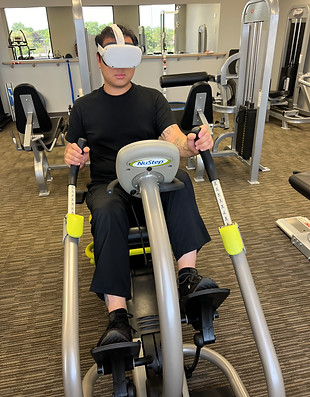
Bike, Nu-Step, & Standing Frame Compatible
-
Weight Bearing & Weight Shifting
Virtual reality in stroke rehabilitation
Virtual reality–based stroke rehabilitation provides an interactive, task-specific therapy environment that improves patient engagement while supporting repetitive motor, balance, gait, and cognitive training. When combined with conventional therapy, VR may improve upper limb function, balance, mobility, and activity participation after a stroke.
It uses immersive or screen-based games/simulations to help patients practice movement, balance, walking, cognition, and daily activities in a motivating, measurable way.
Recent evidence suggests VR is best used as an adjunct to conventional PT/OT, not as a full replacement. The 2025 Cochrane review found VR may improve arm use, balance, and activity limitation, with few reported side effects such as dizziness, headache, pain, or faintness.


Virtual Reality and Its Role in Treating Autism Spectrum Disorder (ASD)
Virtual Reality (VR) is emerging as a promising tool in the treatment and support of individuals with Autism Spectrum Disorder (ASD). By creating safe, controlled, and engaging environments, VR allows therapists, educators, and researchers to teach social, communication, behavioral, cognitive, and daily living skills in ways that may be difficult to achieve through traditional methods alone.
Autism affects approximately 1 in 31 children in the United States according to recent estimates from the Centers for Disease Control and Prevention. Common challenges include social interaction, communication, sensory processing, emotional regulation, executive functioning, and adaptive behaviors.
Why Virtual Reality Works for Autism
Many individuals with autism are visual learners and often benefit from structured, predictable environments. VR offers:
-
Controlled environments with minimal distractions
-
Repetitive practice without real-world consequences
-
Immediate feedback and reinforcement
-
Customizable difficulty levels
-
Safe exposure to challenging situations
-
Increased motivation through gamification
-
Consistent training experiences
VR bridges the gap between clinical therapy and real-world experiences by allowing users to practice skills before applying them in everyday situations.
Advantages of SSIT's VR program for Autism Treatment
Clinical Benefits
-
Individualized treatment
-
Repeatable interventions
-
Objective performance measurement
-
Enhanced motivation
-
Safe skill acquisition
Research Benefits
-
Standardized training environments
-
Data collection capabilities
-
Behavioral tracking
-
Quantifiable outcomes
Family Benefits
-
Potential for home-based therapy
-
Increased accessibility
-
Greater practice opportunities between therapy sessions

The Potential of VR for Treating Military Injuries and PTSD. Virtual reality (VR) immersive environments have shown promise in treating military injuries and post-traumatic stress disorder (PTSD).
AT SSIT, We are Pioneers in Exploring Potential of our Customized Virtual Reality Environments for Treating Military Injuries and PTSD
Virtual reality (VR) immersive environments have shown promise in treating military injuries and post-traumatic stress disorder (PTSD). Here are some ways VR can be used:
1. Exposure Therapy:
-
Simulating Traumatic Events: VR can recreate the traumatic events experienced by soldiers, allowing them to face their fears in a controlled environment.
-
Gradual Exposure: By gradually exposing individuals to the traumatic memories, they can learn to manage their anxiety and fear responses.
2. Pain Management:
-
Distraction: VR can provide a distraction from physical pain, helping soldiers cope with their injuries.
-
Mindfulness Techniques: VR can be used to guide soldiers through mindfulness exercises, which can reduce pain perception.
3. Cognitive Behavioral Therapy (CBT):
-
Skill Building: VR can be used to practice cognitive and behavioral skills, such as relaxation techniques and problem-solving strategies.
-
Social Anxiety: VR can simulate social situations, helping soldiers with social anxiety to overcome their fears.
4. Physical Rehabilitation:
-
Virtual Environments: Soldiers can engage in physical therapy exercises in virtual environments, making rehabilitation more engaging and effective.
-
Goal-Oriented Tasks: VR can provide goal-oriented tasks that can motivate soldiers to work harder and achieve better outcomes.
5. Mental Health Support:
-
Relaxation and Mindfulness: VR can be used to guide soldiers through relaxation and mindfulness exercises, promoting mental well-being.
-
Social Connection: VR can create virtual social environments where soldiers can connect with others who have similar experiences.
Key Benefits of VR for Military Injuries and PTSD:
-
Controlled Environment: VR allows for controlled exposure to traumatic memories, reducing the risk of re-traumatization.
-
Personalized Treatment: VR can be tailored to the individual needs of each soldier, providing a more effective treatment approach.
-
Engaging and Immersive: VR can make therapy more engaging and enjoyable, increasing adherence to treatment.
Note:
While VR has shown promising results, it's important to note that it is not a cure-all. It should be used in conjunction with other evidence-based treatments and under the guidance of mental health professionals.
Would you like to know more about specific VR applications for military injuries and PTSD, or about the research supporting its use?